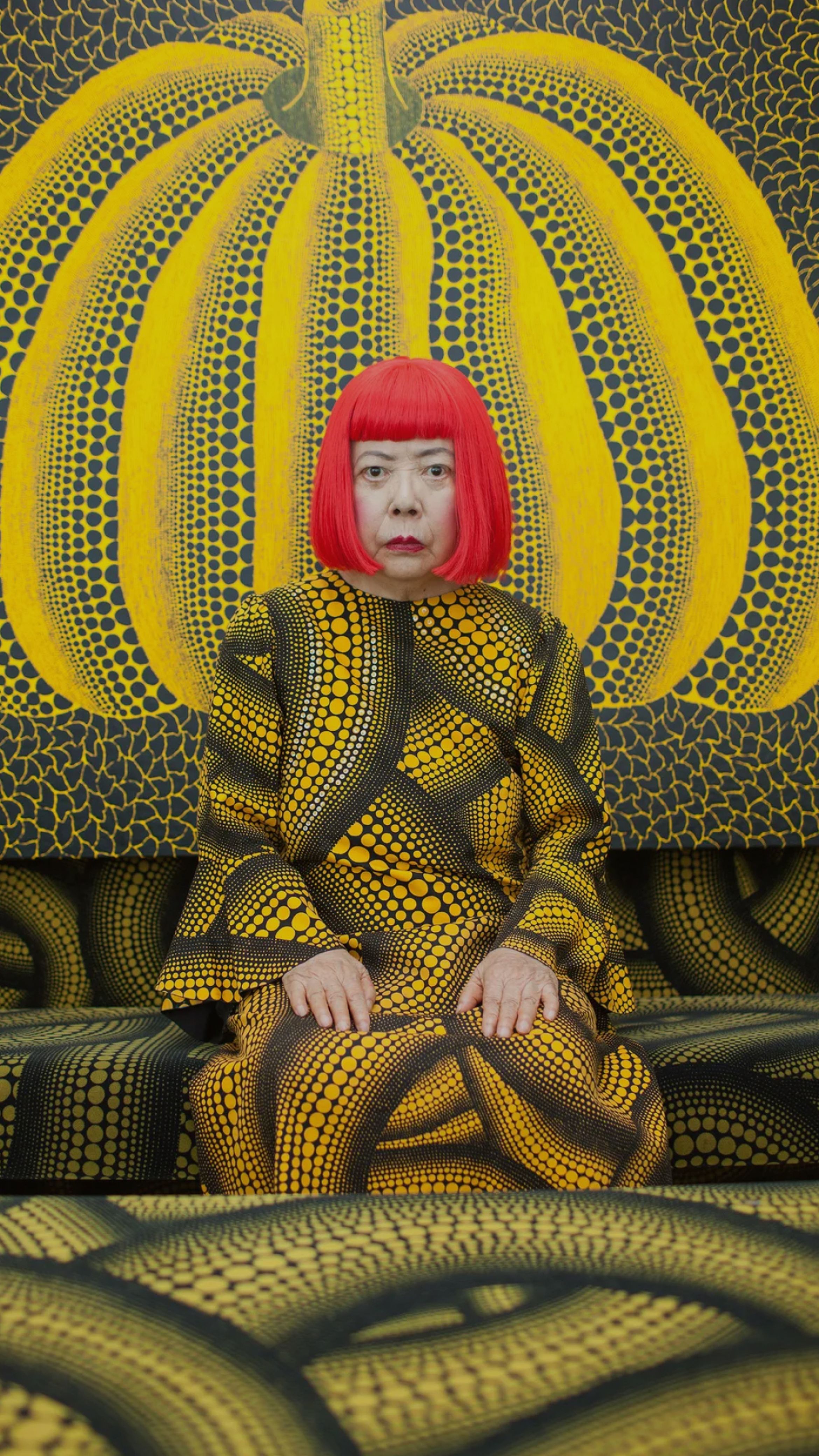
There has been much discussion about whether, how and under what pretence Yayoi Kusama agreed to the campaign that Louis Vuitton have embarked on in her name.
However, seeing shops invaded by uncanny animatronics, social media awash with polka-dotted supermodels and a 400-strong product range stretching from silk ties to surf boards, a better question might be how such a spectacle came to be in the first place?
It’s difficult to imagine an artist of comparable stature to Kusama, but who isn’t an elderly Japanese woman living voluntarily in a psychiatric institution, being turned into a terrifying robot – eyes frenetic, devoid of humanity – and trapped behind the windows of a luxury boutique. A justification proffered has been the millions of people which such a collaboration introduces Kusama and her art to.
However, is an introduction lacking any nuance or meaningful context – and which furthers the lazy caricature of Kusama as 'the polka dot lady’ and nothing more – one worth making? An introduction, that is, for a trailblazing painter, sculptor, poet and performer who has influenced numerous canonical figures, from Warhol to Cornell, and usurped a plethora obstacles to place herself amongst history’s most illustrious artists.
Yayoi Kusama Fashion Company, 1968
Anti-War Happening, 1968 – Kusama protests for peace on the Brooklyn Bridge with a troupe of nude accomplices
55 years later, Kusama returns to New York City in robot form – trapped behind the windows of a Louis Vuitton boutique
It is important to note that Kusama is not without her own controversies. The 93-year-old has made flagrantly racist remarks on multiple occasions, including in a passage from her autobiography recalling encounters with Black people in New York City. The passage was removed from English translations of the book – shielding many from a more complete, more challenging understanding of the world view expressed in Kusama’s writing. Should the publisher have removed content guaranteed to cause offence, and to what extent is context a moral obligation? If nothing else, such questions elucidate the risks of endeavours – like Vuitton’s – which lack the depth to support their breadth.
Yayoi Kusama in her New York City studio, 1960
Yayoi Kusama made her first Infinity Net paintings in the early 1960s – irregular, looping brushstrokes have recurred in her work ever since
Nuance aside, what about the fashion? A cursory glance through Kusama’s oeuvre would reveal endless moments more interesting and relevant to the sartorial world than the motifs profiteers have deemed her most marketable, or easiest to print on monogrammed leather. The dresses she made in the 1960s, for example – designed for multiple occupants, modelled on Manhattan rooftops and sold on Sixth Avenue; the hypnotic restraint of her Infinity Nets; the eccentric pacifism of her anti-war Happenings.
Anything at all, other than dots.
Kusama Fashion Company, 1968
One Thousand Boats Show, 1963
Mass appeal and conceptual rigour present a difficult balancing act, perhaps, but while a museum pushing ticket sales to support its programme is understandable, what’s Vuitton’s raison d’etre? Is Bernard Arnault – richest man in the world – versed in self-obliteration?
Yayoi Kusama talks about infinity in the same breath as joy, freedom, enlightenment and love. By contrast, for a fashion conglomerate obsessed with growth at any cost, infinity means only one thing. Cold hard handbag cash.
Go deeper
Georgina Adam considers Kusama's consent for The Art Newspaper, while Glenn Scott Wright – director of Victoria Miro and close Kusama collaborator – shares his take on Instagram.
Peruse Vuitton's collection and decide for yourself.
Read Kusama’s autobiography, Infinity Net, for her own version of events, and visit Yayoi Kusama: 1945 to now at M+ in Hong Kong for a less leathery take on the legacy of our most popular living artist.
Have thoughts?
Avant Essays are short(ish) opinions on art, written by anyone with an opinion on art. Have something to say? Get in touch.